



Reconstructing Long-term Landscape Evolution of an Uplifting Mountain Using Cosmogenic ¹⁰Be in a Sediment Source-sink System
- Research Reports
Mountain ranges in tectonically active regions undergo gradual morphological changes over long periods through the simultaneous processes of uplift—driven by factors such as fault activity—and erosion by rivers and on hillslopes. Clarifying the developmental process of these mountains is crucial for understanding how landforms are shaped, the timescales involved, and the progression of erosion and sediment production.
A research team—including Yoshimasa Ota (Doctoral student, Graduate School of Science), Yuki Matsushi (Professor, Disaster Prevention Research Institute), Shigehiro Katoh (The Museum of Nature and Human Activities, Hyogo, Sanda, Japan), and Hiroyuki Matsuzaki (Professor, The University of Tokyo)—focused on the cosmogenic nuclide ¹⁰Be accumulated in quartz within sediments. They conducted a study to reconstruct and verify the long-term geomorphic evolution of an uplifting mountain range, specifically targeting the Rokko Mountains in southeastern Hyogo Prefecture and Osaka Bay.
The results of this study have been published online in the international academic journal Earth and Planetary Science Letters, Elsevier on 12 June 2026.
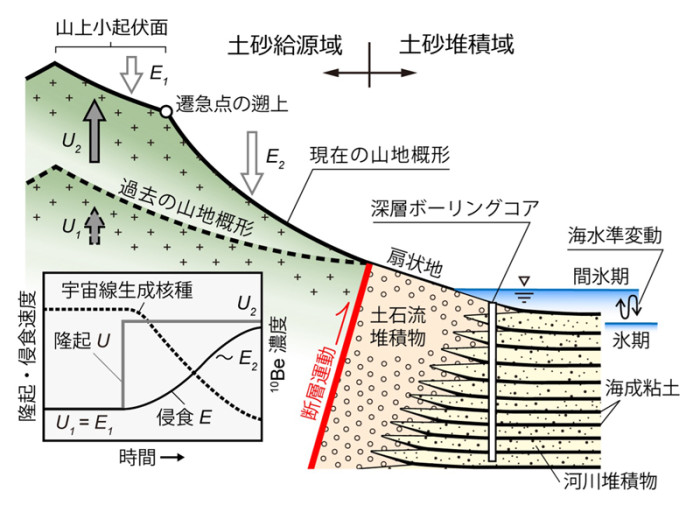
- Reconstructing Long-term Landscape Evolution of an Uplifting Mountain Using Cosmogenic ¹⁰Be in a Sediment Source-sink System [Kyoto University]
- Reconstructing Long-term Landscape Evolution of an Uplifting Mountain Using Cosmogenic ¹⁰Be in a Sediment Source-sink System [Kyoto University – Press Release Details]